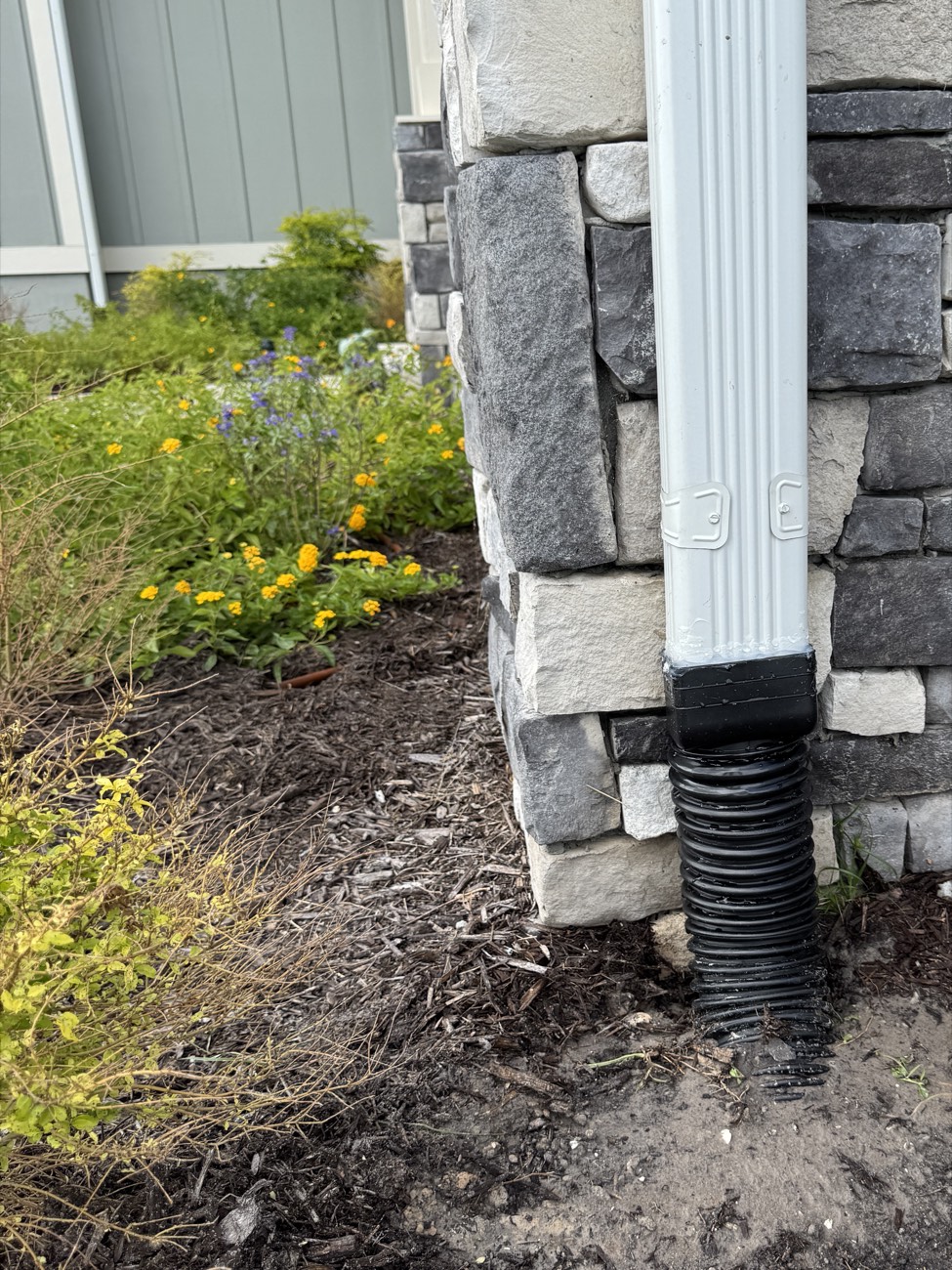
Here's something we run into almost every week in Ponte Vedra, Nocatee and St. Augustine: a house with beautiful gutters — clean, straight, properly pitched — and a soggy, sunken strip of mulch running right along the foundation.
The gutters aren't broken. They're doing their job perfectly. The problem is what happens after the downspout.
Gutters catch it. Drainage carries it away.
Think of it as a relay race. Your gutters run the first leg — they catch rain off the roof and funnel it to the downspouts. But a downspout that just dumps onto a splash block hands the baton to nobody. All that water lands three feet from your slab and soaks straight down.
And it's a lot of water. A 2,000 sq ft roof sheds roughly 1,250 gallons in a single inch of rain — and Northeast Florida averages well over 50 inches a year. In an afternoon thunderstorm, one downspout can put hundreds of gallons into one spot in your yard.
Drainage runs the second leg. A buried line takes the downspout's output and moves it somewhere useful — the street, a swale, a dry well, or a pop-up emitter out in the yard where it can spread out and soak in harmlessly.
What "only half the job" looks like
You can usually spot a home with gutters but no drainage:
- A trench or eroded channel in the mulch under each downspout
- Mulch and soil washed onto the driveway after every storm
- A patch of lawn that stays soggy for days while the rest dries out
- Mildew or staining low on the siding or brick near a downspout
- Mosquitoes breeding in standing water that never quite disappears
And the reverse happens too. We've seen yards with a properly built French drain that still flood — because the gutters above them were clogged, sagging, or missing entirely, so roof water poured over the edge and landed outside the drain it was supposed to feed.
Why this matters more in Florida
Our conditions make the handoff especially important. Sandy soil drains fast right up until it doesn't — and once it's saturated, water sits. Our water table sits high, so there's less room underground for a downpour to disappear into. And a lot of our lots are flat, which means water doesn't have anywhere obvious to run.
Add a summer storm season that regularly drops two or three inches in an hour, and "it'll soak in eventually" stops being a plan. Water that repeatedly saturates the soil beside a slab is how you end up with foundation movement, rotted fascia, dead sod and a lanai that floods.
How we connect the two
When we do a full job, the two systems get designed as one. Typically that means:
- Seamless gutters sized and pitched for the roof's actual runoff
- Downspouts placed where a drain line can realistically be routed
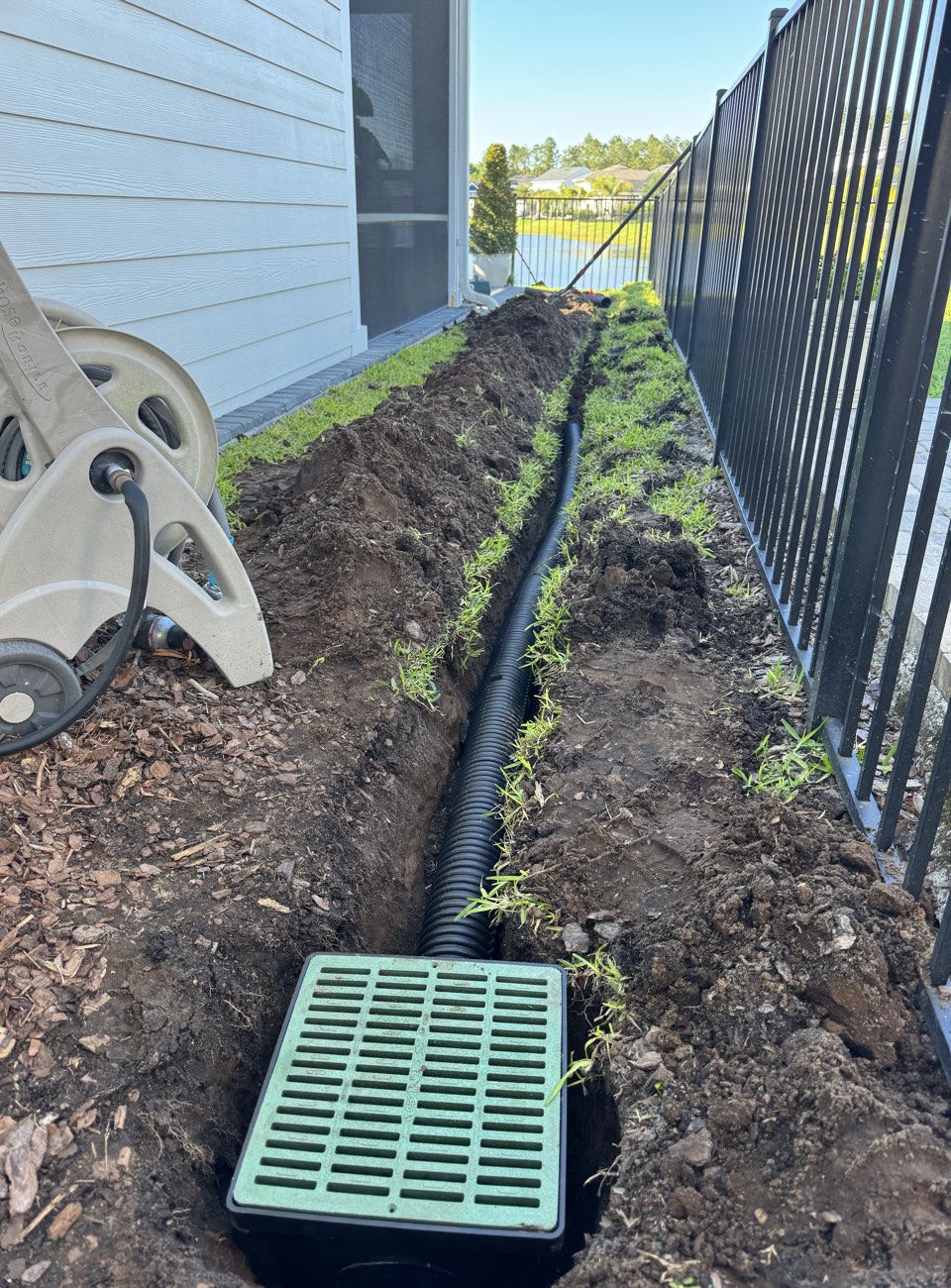
- A buried solid pipe taking each downspout well away from the foundation
- Catch basins where the yard already collects water
- A pop-up emitter or outfall that discharges somewhere it won't cause a new problem — or your neighbor one
- Gutter guards where oaks and pines would otherwise clog the whole chain
That last one matters more than people expect. A clogged gutter doesn't just overflow — it can back debris down into the drain line, and now you've got a blockage underground where you can't see it. It's why we treat gutter cleaning and drainage cleaning as related maintenance, not separate chores.
The simplest test
Next time it rains hard, put on a jacket and walk your property. Look at where every downspout ends and ask one question: where does this water actually go?
If the answer is "into the mulch right here," you've got gutters doing half a job. If you find water pooling somewhere with no gutter above it, you've got a drainage problem that gutters alone won't fix. Either way, you now know which half is missing.
🌴 We do both — on purpose
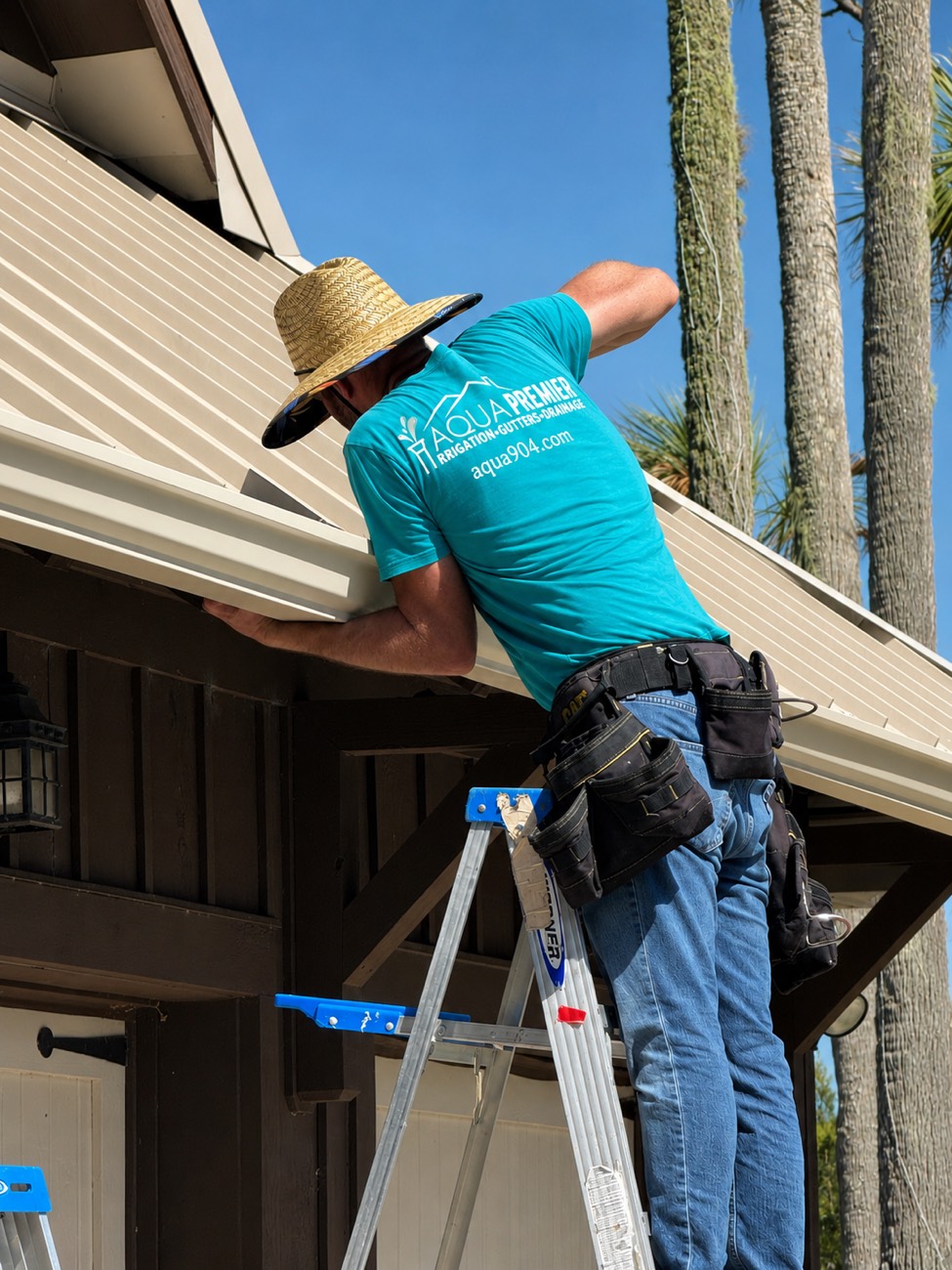
Plenty of companies hang gutters. Plenty dig drains. We do both because we got tired of being called out to fix the half somebody else skipped. When one crew designs the whole path — roof to gutter to downspout to buried line to outfall — the water has somewhere to go and stays there.
If you've got a soggy spot, an eroding bed, or a downspout dumping at your slab, schedule a visit and we'll walk it with you. Learn more about our seamless gutters and drainage solutions.
Water ending up where it shouldn't?
Schedule a visit and we'll look at the whole path — gutters, downspouts and drainage — and tell you which half needs the work.